
Is Trans a Mental Illness?
The Hard Truth Part 1

Click the play button below to hear a 7-minute AI reading of this article.
Truth is often hard to take. In 2024, the fact I joined millions of others worldwide with stage IV Tongue Cancer wasn’t easy to swallow. Either was anything else actually.
No matter how hard I tried to deny it, the truth wouldn’t go away. That’s life.
I imagine for many who’ve been through the pipeline of puberty blockers, hormones and surgery, there’s quite a few hard truths to confront.
One would be that no matter what drugs or surgery they might have had, the depression, anxiety, and emotional ups and downs won’t go away. They may cosmetically look a bit different, but the problem they thought could be fixed with drugs and surgery was, quite literally, in their head.
For those at the very end of the trans-pipeline, this hard truth goes hand in hand with another. It’s impossible to reverse what has been done to them.
So here’s the rub. Even if drugs and surgery could be reversed, the problem inside their head remains. It was there before the whole gender thing was considered.
Body altering medical interventions can never silence the despairing voices inside their head. The depression, the fear, the distrust, stay to ruin things just as it did when they were 10, 20 or whatever age they entered the gender transition pipeline. This realisation adds another layer of despair to an already isolated existence.
What does the research say?
What comes next are facts based on scientific research I had no part of. The research is published and peer reviewed. I didn’t make it up to make trans folk look sick.
Researchers in Psychiatry from Seattle’s University of Washington and others from the Cleveland Clinic Ohio, studied 10,270 transgender patients with a median age range of 35-39 years. Now this isn’t a small sample. It’s frightening that such a sample size exists at all.
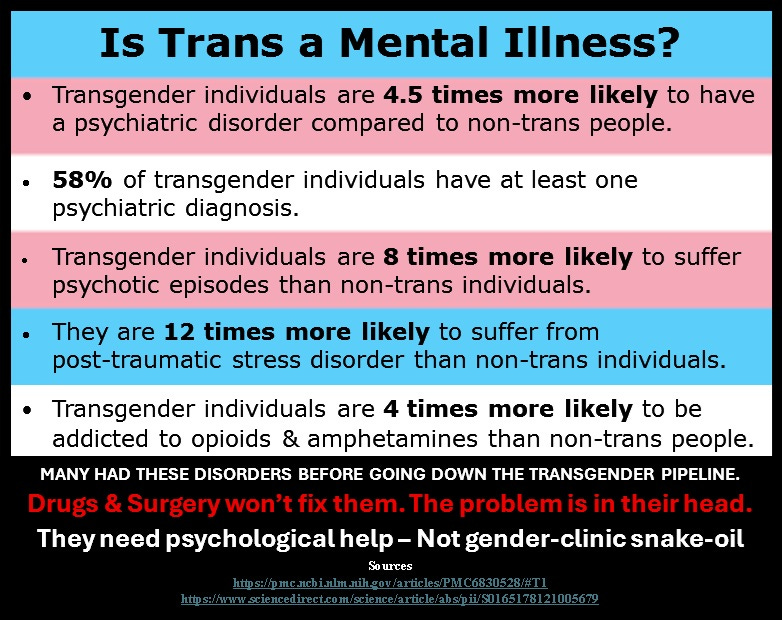
From this sample, 5,940 individuals or 58% had at least one psychiatric diagnosis compared with 13.6% of the American control population - a mighty sample of over 53 million non-trans people.
In other words, transgender folks are 4.5 times more likely to have a psychiatric disorder compared to non-trans people.
Major depressive and generalized anxiety disorder were the most common, while substance abuse, bipolar disorder and schizophrenia came next.
Trans folk were 8 times more likely to suffer psychotic episodes than non-trans individuals. They were 12 times more likely to suffer from post-traumatic stress disorder.
Not surprisingly, trans individuals are 4 times more likely to have a dependence on opioids or amphetamines.
Now I don’t expect you to believe one study. Always get two opinions. It’s what I should have done early when my swallowing problem started.
In 2021, doctors from the Department of Psychology at Michigan State University, undertook a review of all available research. This is where they look at every study and summarise the important findings into one, readable document.
All studies agreed that trans individuals are at greater risk of schizophrenia and psychosis. But it’s the discussed causes of these illnesses that are frightening.
Horrifically, nearly every study reported the cause of this could result from misdiagnosis due to bias and inadequate training, or else discrimination and violence targeting the transgender community.
Now hold on.
We know that trans individuals are more likely to have difficulty negotiating wider society. Some of this is due to their extreme demands that impinge on the rights of most of us, especially women. This isn’t discrimination. It’s disagreement.
Now that the use of accurate descriptors like man, woman, binary etc can be considered forms of violence against trans folk, the whole violence cause must be taken with a grain of salt.
BUT, according to every study, a possible cause of trans mental health issues could be that the poor individuals were misdiagnosed by poorly trained gender-biased doctors. The patients, presented persuasively with the gender dysphoria diagnosis, may have just grabbed it as a way out of misery! They just wanted a new life! After exiting the pipeline and realising this, who wouldn’t be pissed off and depressed!
For academic research to state this should see gender clinics close down world-over. It hasn’t.
Imagine the 12 year-old who after a childhood of possible abuse, Autism Spectrum Disorder, neglect or parental depression, finds themselves failing, friendless, hating life and wanting out. Reddit groups are talking up gender change. Maybe that would help?

The poorly trained doctor, drilled with gender nonsense from woke-city university, jumps to the progressive yet incorrect diagnosis that the child is gender dysphoric.
Mum, asked if they want a healthy son or a dead daughter, goes along with it. Dad, if asked, will disagree at first, yet eventually give the nod. The pipeline is prepared.
The research cited above was on those who had transitioned. There was no analysis of the mental health of the sample before they transitioned.
However, in the few studies that have looked at the mental health of those presenting with gender dysphoria, it seems depression, isolation, autism, bi-polar and general anxiety are all present well before they enter the gender transition pipeline.
These patients don’t need drugs or surgery. They need psychological help and social guidance. Often, so do their parents or carers. A relevant Australian study can be viewed HERE.
So…
Gender dysphoria is formally classified by psychologists and psychiatrists as a mental illness. It’s categorised as such in the Diagnostic and Statistical Manual of Mental Illnesses (or DSM-5 for short) used by mental health professionals worldwide.
It is beyond doubt that transgender individuals are far more likely to suffer from previously untreated mental health issues than the general population. These mental health issues do NOT disappear with gender transitioning, but persist or get worse.
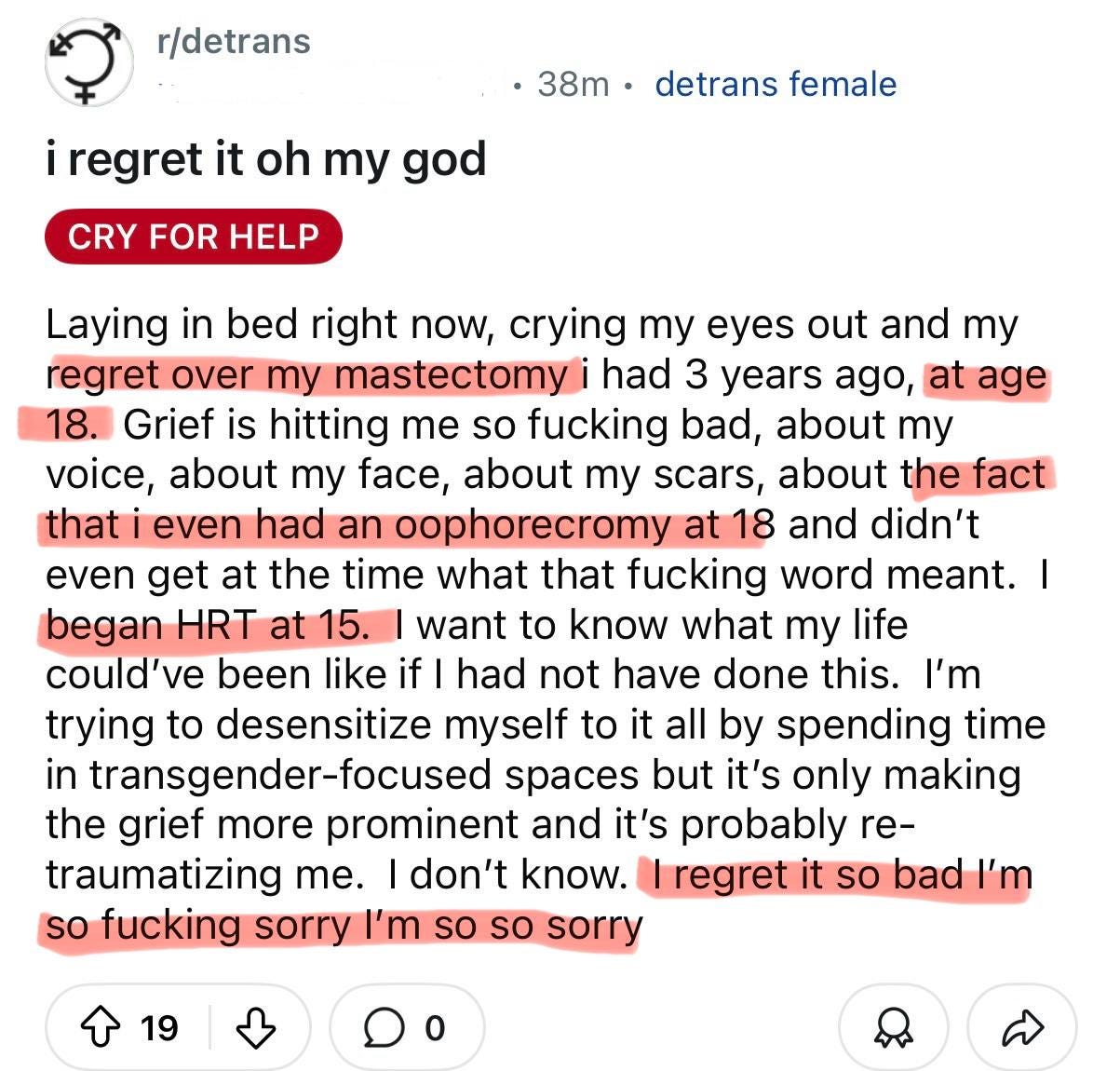
For many, their mental health deteriorates more on the realisation they’ve been guided down an unnecessary pathway by biased, incompetent doctors.
To say so is NOT transphobic. It is true.
Sources:
https://pmc.ncbi.nlm.nih.gov/articles/PMC6830528/#T1
https://www.sciencedirect.com/science/article/abs/pii/S0165178121005679